If you’re brand new to guitar and wondering what you should do first, this is it – start with basic guitar chords for beginners!
You’ll be able to play a ton of your favorite songs in no time with just 7 basic chord shapes – no matter what style of music you love, whether its mainstream or indie, or even what language its in.
These basic chords are the foundation I use again and again when teaching adult beginners and kids because they’re simple, practical, and versatile!
Let’s get started.
Disclosure: This post contains affiliate links and I could earn a commission if you make a purchase using them. This comes at no additional cost to you and all opinions expressed are my own. Thank you for supporting our family and helping me to create more homeschool and music education content!
What Makes It a Beginner Guitar Chord?
Some chords are definitely easier than others!
Beginner guitar chords usually have a few things in common:
- They use open strings which sound full and forgiving
- They don’t require an extreme amount of finger stretching or unnatural shapes
- They show up in a ton of songs you already love
- They transition well into other beginner chords
All seven chords in this post check all of those boxes so they work well or beginner guitarists.
At the time of writing this post, I’m teaching my 8 year old daughter (with very small hands!) how to play these full chord shapes too.
When she was 6 years old, I taught her these easy variations guitar chords first since she has trouble stretching her little hands then.
How to Read Guitar Chord Charts
It can be a little tricky to read a guitar chord chart for the first time.
But once you get the hang of it, you’ll be speed reading them in no time.
Imagine that someone is holding your guitar straight ahead of you like this.
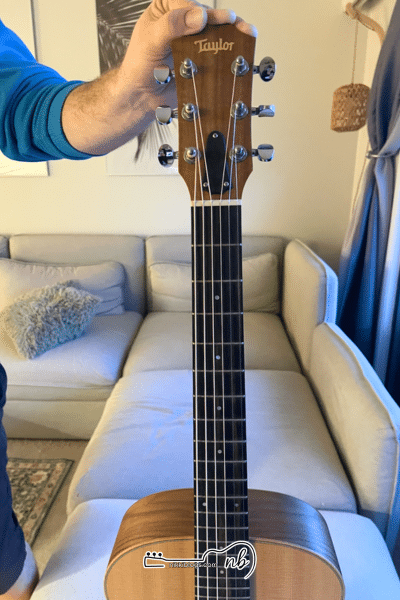
When you see a guitar chord chart, that’s the angle your looking at it from!
Here’s a view of a guitar’s fretboard next an empty guitar chord chart.
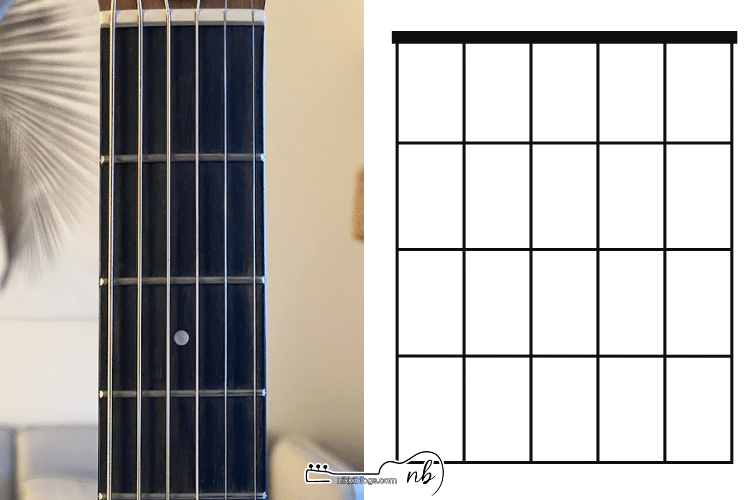
The vertical lines on the guitar chord chart represent the strings.
And the horizontal lines represents the frets.
Now, you may have also noticed that guitar chord charts have several different symbols on them.
Here’s what they mean:
- O – open string – play this string without putting any fingers on it
- X – don’t play this string
- 1 – use your first finger (index) to play this string
- 2 – use your second finger (middle) to play this string
- 3 – used your third finger (ring) to play this string
- 4 – use your fourth finger (pinky) to play this string
Guitar String Order
Something I found pretty confusing as a beginner was guitar string order.
You’ll often hear strings called by either their letter name or a number – for instance, B string or second string.
Guitar strings are numbered from the thinnest string to the thickest string like this.
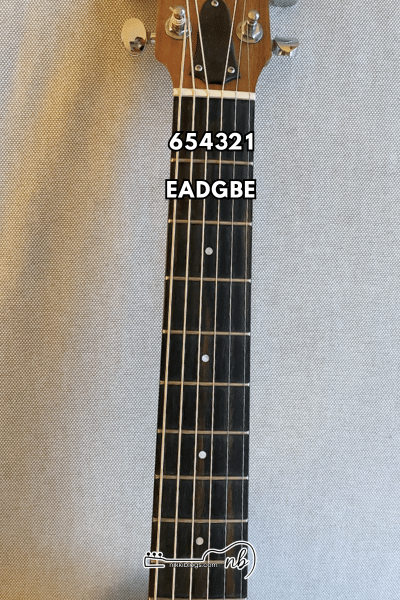
Since your looking at the guitar top down, it can feel a little counterintuitive!
You’d think that the first string is the one closest to your point of view but its the complete opposite.
Your sixth string, the one closest to you when you’re looking down at your guitar on your lap is called your low E string because it makes the lowest, deepest sound (we refer to it as low E because there’s a high E string on your guitar too).
Think of it like reading your guitar chord chart from right to left like this:
- 6th string: Low E (thickest string on your guitar that makes the lowest sound)
- 5th string: A
- 4th string: D
- 3rd string: G
- 2nd string: B
- 1st string: High E (thinnest string on your guitar that makes the highest sound)
It’ll take some time to memorize your string names and order (you honestly don’t have to when you’re starting out) but you can use a cute acronym to help.
I like these ones:
- (E)very (A)mazing (D)ay (G)od (B)lesses (E)veryone
- (E)very (A)ngel (D)oes (G)ood (B)efore (E)vening
The 7 First Beginner Guitar Chords You Need to Know
E Minor Chord (Em)
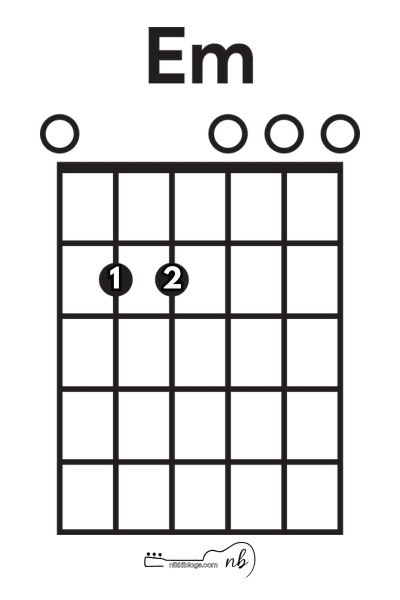
If there’s one chord that gives beginners confidence immediately, it’s got to be Em!
This is a beautiful chord that comes up again and again in all genres of music.
Em and Asus2 are usually the first two chords I teach kids to play because it builds instant confidence!
To play an Em, place your 2nd finger (middle) on the second fret of your fifth string (A).
Then, place your 3rd finger (ring) next to it on the second fret of your fourth string!
That’s it!
Make sure that you’re pressing down on the strings hard enough for all of them to ring out.
Beginner Tip:
If you find it awkward to use your 2nd and 3rd fingers (middle and ring) to press these strings, you can also use your 1st and 2nd fingers (index and middle) instead.
Teaching yourself to play an Em chord with your 2nd and 3rd fingers does set you up for quick chord changes to an E major later on though.
A Major Chord (A)
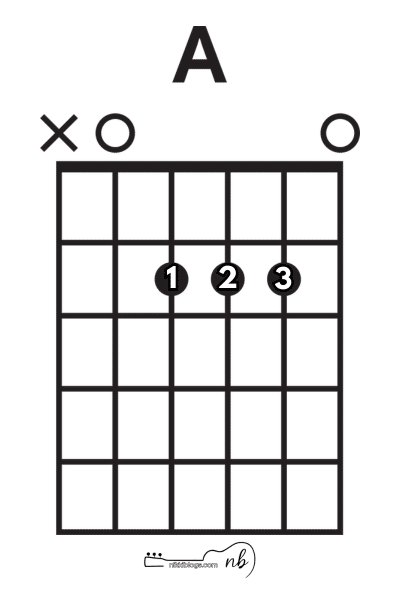
A is usually easier than it looks – like the Em chord we just learned, all you need to do is line up your three fingers together on three strings that are next to one another.
To play an A major chord, place your 1st finger (index) on the second fret of your fourth string (D).
Place your 2nd finger (middle) on the second fret of your third string (G).
And finally, place your 3rd finger (ring) on the second fret of your second string (B).
Beginner Tip:
If this chord feels a bit cramped, you could try stacking your fingers slightly angled instead of straight across.
If you’re playing an electric guitar, you could also use your third finger (ring) to bar these strings.
Personally, I find this way to difficult to do on an acoustic guitar because the strings are much thicker and require more pressure.
E Major Chord (E)

E major is one of the most important foundational chords in guitar playing – you’ll see it a lot in country and folk music!
This one uses three fingers close together and once you learn it, it sticks.
To play an E major chord on your guitar, place your 1st finger (index) on the first fret of your third string (G).
Then, place your 2nd finger (middle) on the second fret of your fifth string (A).
Finally, place your third finger (ring) on the second fret of your fourth string (D).
A Minor Chord (Am)

Ah, A minor – this was the first chord I ever learned to play on my guitar, so its dear to me.
House of the Rising Sun, anyone? Haha!
Am introduces new emotional color without overwhelming beginners.
You may have already noticed that its the exact same shape as our E major chord and uses the same three fingers on three strings that are right next to each other too.
Kind of like E minor to Asus2, you can think of your A minor as an E major chord moved over one spot.
To play an A minor chord on your guitar, place your 1st finger (index) on the first fret of your second string (B).
Then, place your 2nd finger (middle) on the second fret of your fourth string (D).
Finally, place your third finger (ring) on the second fret of your third string (G).
G Major Chord (G)

G is one of the most fundamental guitar chords that a beginner can learn but it can feel pretty awkward at first!
G uses three fingers, two on the third fret and one on the second fret.
To play a G major on your guitar, place your 1st finger (index) on your fifth string (A) on the second fret.
Then, place your 2nd finger (middle) on your sixth string’s (the thickest E string on your guitar) third fret.
Finally, you’ll need to do a little stretch and place your 3rd finger (ring) on the third fret of your first string (the thinnest E string on your guitar).
Like other chords on this list, G is considered an open chord because it incorporates open strings meaning you don’t have to put fingers down on all strings to play the chord.
Beginner tips:
If your G chord sounds muted, check that your fingers are curved and not collapsing flat on your strings.
And if you’re struggling to reach that last string with your ring finger, try playing a G6 instead!
It uses just the two lower strings of this shape (2nd finger on the sixth string’s third fret and your 3rd finger on the third fret of your sixth string).
C Major Chord (C)
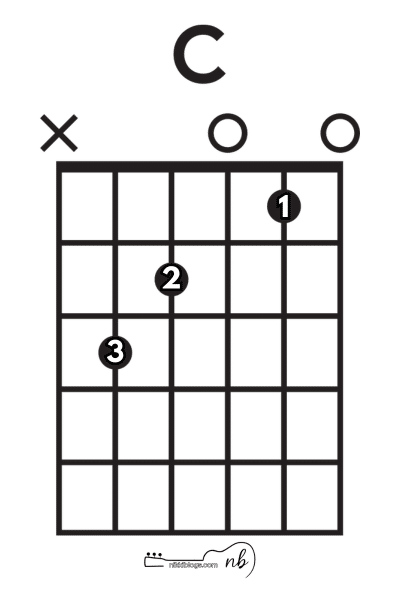
C is a classic beginner shape but it can feel challenging at the beginning – especially for kids or those with small hands (like yours truly!) but it’s worth the effort.
But with a little bit of practice, it’ll get easier for you too.
To play a C major chord on your guitar, place your 1st finger (index) on the second fret of your guitar’s second string (B).
Then, place your 2nd finger (middle) on the second fret of your fourth string (D).
Finally, place your 3rd (ring) finger on the third fret of your fifth string (A).
Make sure your curl your fingers so every string rings out!
Make It Even Easier:
Don’t rush this chord!
For younger students, I often start with a Cmaj7 chord instead of the full C chord – like G6, it uses just the two lower strings (E and A) that make up a standard C chord.
To play a Cmaj7, place your 2nd finger (middle) on the second fret of your guitar’s fourth string (D) and your 3rd (ring) finger on the third fret of your fifth string (A).
D Major Chord (D)
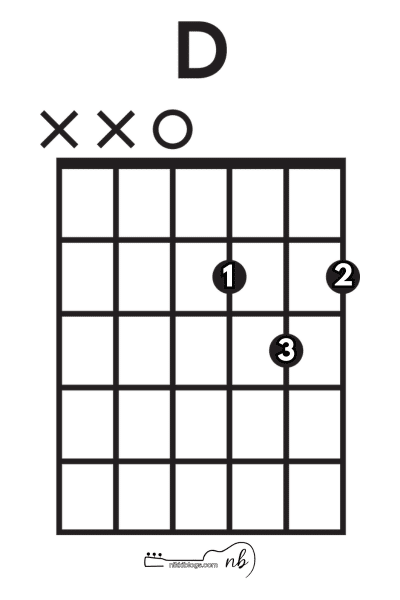
D is such a confidence booster once it clicks – and to be honest, I played this one wrong for years before I finally trained myself to play it the right way, haha!
To play a D major chord on your guitar, place your 1st finger (index) on your third (G) string’s second fret.
Then, place your 2nd finger (middle) on your first (high E) string’s second fret.
Finally, place your 3rd finger (ring) on your second (B) string’s third fret.
Beginner tips:
Keep your fingers close to the frets and let your wrist angle slightly forward naturally.
If you still find this chord awkward to play though, you can try using your first finger (index) to bar the second fret of your top three strings (E, B, and G) and hold down the third fret of your fifth string with your third finger (ring).
I know its a bit of an unconventional and ugly way to play this chord, but it works.
More Music & Guitar Tips:
- How to Create a Gorgeous & Functional Home Music Room
- Best Electric Guitar for Beginners: We Tried Dozens, Here are Our Top Picks!
- Our Honest Loog Guitar Review: Does It Really Help Kids Learn?
- Here’s The Best Way to Learn Guitar at Any Age: What I Did Differently This Time Around
Easy Chord Progressions Using These 7 Chords
Once you know these chords, you can start stringing them together right away.
Here are a few beginner-friendly progressions to try:
- G – C – D
- A – D – E
- G – D – Em – C
- Am – C – G – D
- Em – G – D – A
Slow strumming is your friend here!
Clean chord changes sound better than quick buzzy transitions.
Get a Capo to Play Hundreds of Songs From the Start
If you don’t have one yet, I’d strongly recommend picking up a capo – this is a great one, especially for the price.
A capo is a small clip that you attach to the neck of your guitar to press all strings at once.
So, if you place it across the first fret, you now treat the capo like its the starting point of your guitar.
Think of your capo like a shortcut tool – it holds strings down for you so you can play the same easy chords but they sound higher without any extra effort!
Let’s say you want to play one of your favorite songs that has a B Minor in it – barre chords can be a real challenge to play for new musicians.
But if you place your capo on the second fret, it’ll take care of the barre for you and you’ll only need to play an A Minor chord shape now.
It really is that simple!
This amazing little tool will allow you to expand the number of songs you play from the beginning and is a huge confidence booster for beginners.
How to Practice Beginner Guitar Chords Without Feeling Overwhelmed
This is especially important if you’re juggling homeschool, work, and everything in between.
- Practice 5 to 10 minutes a day
- Focus on one chord or one transition a day
- Strum slowly and consistently
- Stop before frustration sets in!
For our homeschool, guitar often fits perfectly into morning time or a quiet afternoon reset.
I’ll post a link to my 30 day guitar challenge for learning to play guitar here soon 🙂
You could check out my 30 day Instagram song challenge template to share your favorite songs with friends in the mean time.
Beginner Guitar Chords for Kids (What Actually Helps)
Teaching kids guitar looks different than teaching adults.
What helps most:
- Shorter practice sessions
- Lighter gauge strings
- Smaller or kid-sized guitars (my 8 year old daughter plays this electric guitar and this acoustic)
- Lots of encouragement and zero pressure
Remember that progress doesn’t need to be fast to be meaningful!
Top Homeschool Tips for Busy Families:
- Setting Up Your Homeschool Room: Here’s How to Stay Organized
- How to Create a Homeschool Schedule That Works
- Homeschool Supply Shopping List: Everything You Need and Nothing You Don’t!
- 50 Best Homeschool Field Trip Ideas to Make This Your Best Year Ever
Free Printable: Beginner Guitar Chord Chart
To make this even easier, make sure to download my free printable guitar chord chart that includes all seven of these chords in one place!
It’s perfect for binders, music folders, or hanging near a practice space.
You can click the image or text below to get it now.

Where to Go After Learning These Beginner Guitar Chords
Once these chords feel comfortable, you’re in a great position to move on to:
- Simple strumming patterns
- Two and three chord songs
Check out this post for the best way to learn to guitar and see how I used these basic guitars to play any song I wanted when I was just starting out.
The seven chords we talked about in this post are more than enough to get started and honestly, they’ll be useful forever!
Be sure to check out this post for 50 easy beginner guitar songs.
Final Thoughts on Learning Basic Guitar Chords for Beginners
If your chords don’t sound perfect yet, that’s ok!
Guitar is learned one small win at a time and beginner guitar chords like these will help you build a strong, musical foundation without the overwhelm.
So stick with it and try to take at least 20 minutes a day three times a week to practice playing these chords shapes.
Be sure to save this post and come back to it anytime you want to practice your chords.
Playing music is closer than you think.
Happy strumming, friend!
– Nikki